
Payroll Taxes – What can the IRS do if I miss paying payroll taxes?
As an employer, it is your responsibility to collect, report, and to pay employment taxes. If you do not, your tax case generally gets quickly assigned to an IRS revenue officer to collect any delinquent payroll taxes. Yes, that means trouble. Even worse, it is considered a felony.
 An IRS revenue officer is the most serious IRS representative you can get with broad powers to apply tax liens, tax levies and wage garnishments. When you have unpaid employment taxes, it is one of the most serious offenses you can commit. It is not uncommon that they first come by your business to see what assets they can find, which can be quite uncomfortable, especially if your company has nothing to give.
If they find assets or revenue within your company, that can cover the payroll or employment taxes, they will collect upon your company. Additionally, the IRS can hold you or whomever was responsible personally liable for paying the payroll taxes.
Payroll Taxes – What are the taxes I have to pay relating to my employees?
The following must be withheld from every employee’s pay:
- Federal and state income taxes
- Social Security and Medicare (FICA taxes). These taxes must be reported on Form 941 on a quarterly basis.
- Federal unemployment taxes based on the number of employees, reported on Form 940 for federal on an annual basis.
- Worker’s compensation fees (taxes) to state or federal agencies.
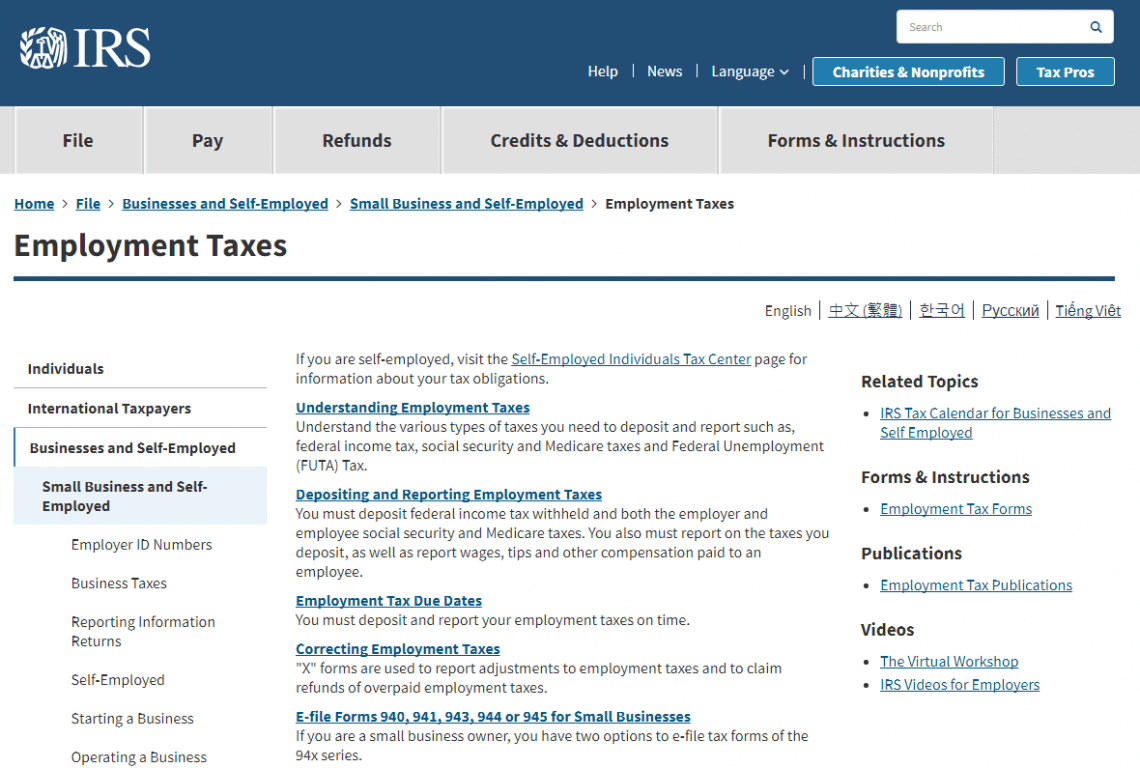
Employment tax due dates can be found at the IRS website by clicking on the following link:
IRS: Employment Tax Due Dates
Personal liability for payroll taxes: The Trust Fund Recovery Penalty
When an IRS revenue officer cannot find sufficient income or assets in your company (from a submitted Form 433B business financial), he or she will look to the owner or whoever was responsible for not paying the payroll taxes. This is called assessing a Trust Fund Recovery Penalty where the amount of these trust fund or employment taxes is assessed to the person responsible.
The revenue officer will conduct an investigation and first conduct interviews to see who in the company is responsible for the unpaid employment taxes. The form the IRS revenue officer uses is Form 4180, Report of Interview with Individual Relative to Trust Fund Recovery Penalty.
Be very clear that despite using a payroll service or someone else to withhold and make deposits, you, the employer, are still very much responsible. It does not relieve you of your responsibility to file and pay timely on behalf of your company.
What Are the Penalties for missing payroll taxes?
- Form 941 penalties (see IRS Publication 15: Employer’s Tax Guide. These penalties are for Form 941 taxes (withholding and FICA taxes) but may also apply to other similar forms.
- Failure to file For Form 941 and similar forms. 2% 1-5 days late, 5% 6-15 days late, 10% more than 16 days late or within 10 days of first notice from the IRS, maximum 15%.
- Trust Fund Recovery Penalty. 100% of the unpaid tax (income, social security, and Medicare). In addition to penalties, interest accrues from the due date.
Additionally, tax liens may be place on your business and eventually on you personally if the tax debt goes uncollected.
Can I make late deposits for payroll taxes?
You can, but here’s what happens: You have tax deposit requirements of $2,000 each month. If you don’t make your March 15 deposit, but you make a deposit of $2,500 on April 15 to catch up. $2,000 will be applied to your April 15 requirement and $500 to March 15. You may also get a penalty assessed to the unpaid portion in March.
In summary, stay compliant with your payroll taxes at all costs. The IRS has been urged go after non-compliant employers as summarized in a recent Forbes article found at:
Forbes: IRS Payroll Tax Enforcement. In it, the author describes an interesting “report” from the Treasury Inspector General for Tax Administration detailing the trend of serious employment tax crimes. Review this report and article and be aware when operating your business with employees.
Taxpayers needing assistance in dealing with employment taxes or payroll taxes and IRS problems should seek the advice of a tax attorney. The San Diego Tax Attorneys at Delia Law have many years of tax resolution experience and will competently represent you before the IRS. Please call for a no-cost tax attorney consultation for tax resolution at (619) 639-3336. We look forward to helping you.
This blog post is not intended as legal advice and should be considered general information only.
Keywords: Payroll taxes, employment taxes, Trust Fund Recovery Penalty, IRS problems, tax liens, tax levies